Float Along Flow
Carries the connected object along a Flow path — a leaf, a toy boat — at the path's speed, bobbing and turning with the current, looping at the end. Uses the nearest Flow path unless one is wired.
Output: effect (wire into an Object Selector)
Inputs
| Handle | Type | Meaning |
|---|---|---|
| path | object | the Flow path to ride — wire an Object Selector picking it |
| speed, bob | number | override the card sliders when wired |
With path unwired it rides the Flow path nearest to where the object was placed, if one is within about 4 m; with none in reach the object stays where it is.
Parameters
| Parameter | Default | Options |
|---|---|---|
| speed | 1 | 0 to 5 — a multiplier on the path's own Speed; 0 holds it in place on the path |
| bob | 0.03 | 0 to 0.3 m — how far it rises and falls on the water |
| align | on | turn the object to face along the current; off keeps its placed facing |
How it moves
- Where you place it sets its lane. The object keeps its height above the path's line and its own turn relative to the current; moving it in the editor re-anchors it there. The placed pose is what the scene saves.
- It always loops. At the end of the path it starts again at the beginning, whether or not the path itself loops.
- The same everywhere. Its spot on the path is worked out from the shared clock, so every player — and anyone who joins later — sees it at the same place with nothing sent. Floaters placed at different spots bob out of step with each other.
- It follows the path's line only, so it needs no particle water to move.
Practical example
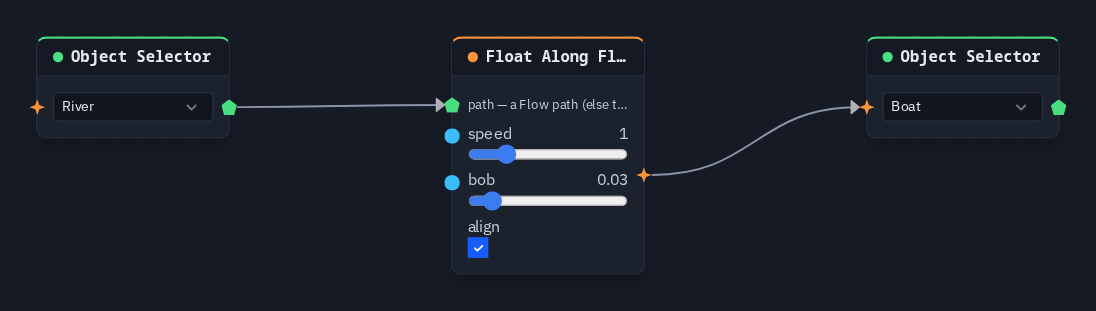
A toy boat on a river:
- Add ▸ Water ▸ Flow path, and place a small object (the boat) on it.
- Add an Object Selector picking the Flow path and a Float Along Flow; wire Object Selector → Float Along Flow's path.
- Add a second Object Selector picking the boat; wire Float Along Flow → it. The boat sails down the river and comes back round at the end.
- Raise speed to 2 for a faster current, or bob for choppier water.
Tip
The nearest-path rule means a leaf dropped on a river needs no path wire at all — wire one when two paths run close together and you want to choose. For a path drawn as a spline, or ping-pong and run-once travel, see Follow Path.