All Players
Fires a pulse once every player in Play answers yes to a condition — the group gate that makes sure nobody is left behind ("everyone is at the portal", "everyone has three laps").
Output: event — wire it into a Travel to scene node's trigger, a Set Game State, or anything else a pulse drives
Inputs
| Handle | Type | Meaning |
|---|---|---|
| condition | boolean | each player answers for themselves — a Compare, a Latch, anything true/false |
Unwired, the answer is no, and the node never fires.
Who counts
- Each player's copy of the graph works out the condition for that player and shares only the yes/no answer. When every player in Play says yes, every copy fires the node on its own (nothing extra is sent, so the pulse is not doubled).
- Only players in Play count. Someone sitting in the editor is a spectator: they never hold the group up. If nobody is in Play, nobody is ready and the node does not fire.
- It fires on the change from "not everyone" to "everyone". If one player drops back to no and then says yes again, it fires again.
The answer is only as personal as the condition you wire in. A per-player value such as
Player Variable mine gives a real per-player answer; a shared value (a
Get Variable, a Counter) is the same for everyone, so the gate then
simply fires when that shared condition comes true while somebody is playing.
Practical example
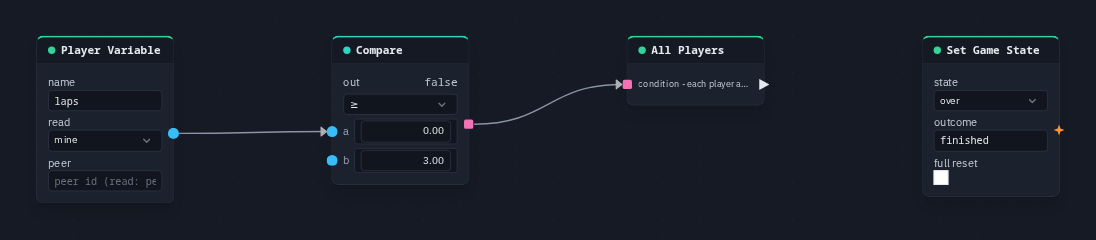
End the race when every player has done three laps:
- Add a Player Variable (name
laps, readmine). - Add a Compare (op
gte, b = 3); wire Player Variable → its a. - Add an All Players; wire Compare → its condition.
- Add a Set Game State (state
over, outcomefinished); wire All Players → its trigger.
Each player's own laps comes from a Set Variable with scope player.
Tip
All Players also works as a "this just came true" detector for a shared condition: a Compare cannot drive a trigger input directly, but Compare → All Players → Set Game State can (as long as someone is in Play).